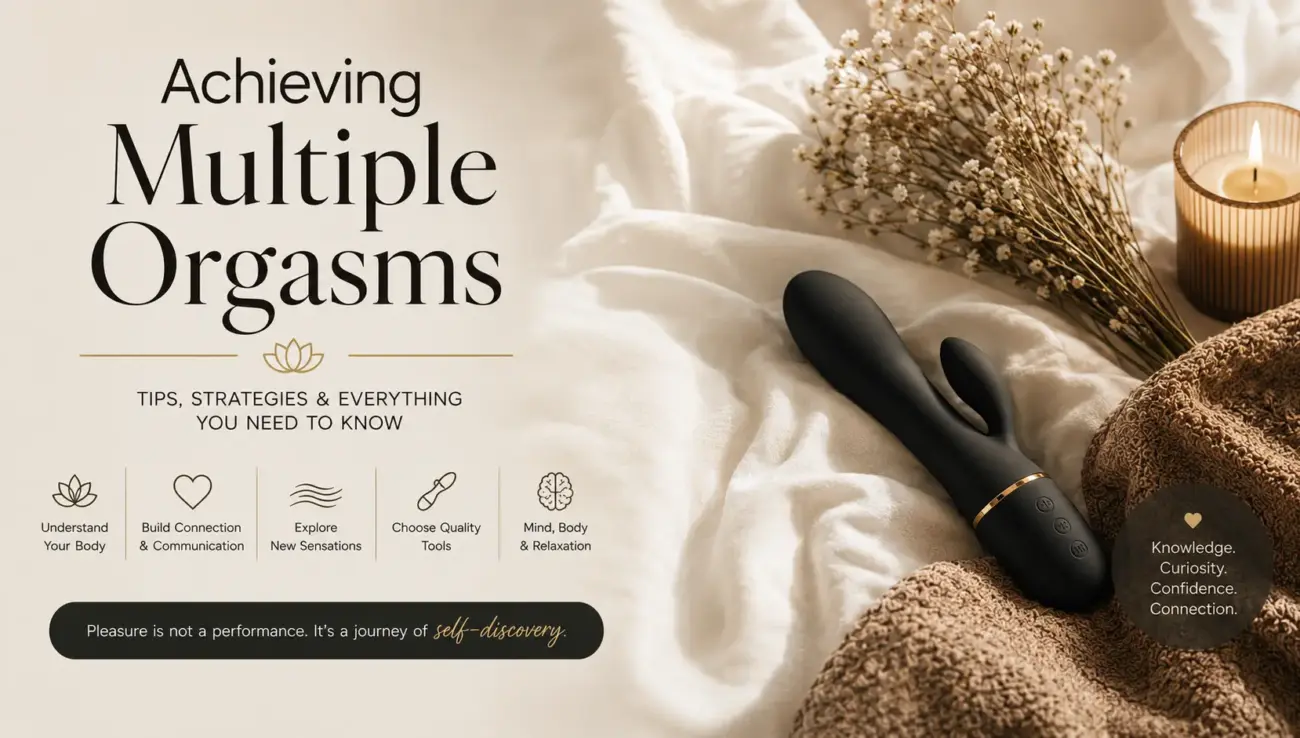
Multiple Orgasms Explained: What the Evidence Says
There’s a quiet myth worth retiring: that multiple orgasms are a finish line, a skill to master, a number to chase.
The story is appealing. If one orgasm feels good, two must be better. Five must mean you’ve unlocked something others haven’t. Magazines and social media reinforce it, usually with a list of five techniques and a product recommendation attached.
The reality is more interesting, and considerably more useful.
Sexual response involves the nervous system, hormones, circulation, emotional state, physical comfort, anatomy, and relationship context — all interacting continuously. There is no universal method because there is no universal body. Some people experience multiple orgasms easily. Others never do, and describe deeply satisfying intimate lives. Most find their experiences shift with sleep, stress, health, and how they feel on a given day.
This guide covers what multiple orgasms actually are, why experiences vary so widely, and what tends to support comfort and enjoyment — regardless of how many orgasms occur.
What multiple orgasms actually are
The term is used casually, but rarely defined.
In practical terms, multiple orgasms means experiencing more than one orgasm during the same encounter without arousal ending completely in between. That definition is simple; lived experience is not.
Sequential
This is the pattern most people picture. An orgasm occurs, sensitivity briefly increases, a recovery period follows, arousal builds again, and another orgasm happens. The interval might be seconds or several minutes.
Continuous
Some people describe orgasmic contractions that blend together without a clear pause — less like separate peaks, more like one prolonged experience with fluctuating intensity. This pattern appears in popular media more often than it appears in people’s actual accounts.
Neither pattern is better. And frequency is a poor measure of anything. One deeply satisfying orgasm is not a less successful experience than several distracted ones.
Why experiences differ so widely
If a single technique guaranteed multiple orgasms, it would have been identified long ago. Instead, several systems work together, and none of them operates in isolation.
The brain and nervous system
Conversations about pleasure tend to focus on anatomy. The brain matters more.
It processes touch, interprets emotional safety, regulates attention, and determines whether a sensation registers as pleasurable, uncomfortable, or simply distracting. Brain imaging research has shown that many regions become active during arousal and orgasm — areas involved in reward, emotion, movement, and sensory integration.
This is why psychological factors have such physical consequences. Stress at work, relationship tension, poor sleep, or simply worrying whether an orgasm will happen all compete for the same attention. When the brain shifts toward monitoring performance rather than experiencing sensation, pleasure becomes harder to sustain.
The nervous system isn’t an on/off switch either. Identical physical stimulation can feel entirely different on different days, because your nervous system is responding to your whole environment — not just to touch.
The pelvic floor
The pelvic floor is a group of muscles at the base of the pelvis. They support internal organs, contribute to bladder and bowel function, and contract rhythmically during orgasm as part of the body’s normal response.
Pelvic floor function is an area where practical steps exist. If you’re new to this, our guide to pelvic floor health covers the basics, and building a kegel habit addresses the harder part — consistency. Some people use weighted kegel balls as part of a routine, though results vary considerably between individuals.
If you experience pelvic pain or persistent discomfort, a qualified healthcare professional is the right starting point — not an article.
Hormones and the recovery phase
Sexual response isn’t governed by one “pleasure hormone.” Dopamine is associated with motivation and anticipation. Oxytocin is involved in connection and trust. Endorphins contribute to the sense of comfort many people notice afterward. Prolactin typically rises after orgasm, and researchers continue to study its role in recovery — including why recovery differs so dramatically between individuals.
That variability is the honest answer to why some people can continue after orgasm and others cannot. Both responses are normal.
What influences your experience day to day
Beyond physiology, several ordinary factors shape how the body responds. None of them is a technique.
Stress shifts attention toward problem-solving. Many people notice arousal develops more slowly during demanding periods, or that concentration becomes harder. This doesn’t mean intimacy is impossible — it means reducing pressure often helps more than adding technique.
Sleep affects energy, mood, concentration, hormone regulation, and stress resilience. After several poor nights, many people notice changes in both desire and responsiveness.
Emotional safety allows attention to stay on sensation rather than self-evaluation. This applies to how you relate to yourself as much as to a partner. Self-criticism and comparison are distractions like any other.
Communication is one of the strongest predictors of satisfying partnered intimacy — and it rarely means detailed instructions mid-encounter. Simple check-ins work: More pressure or less? Would you prefer to pause?
Hormonal changes across menstrual cycles, pregnancy, postpartum recovery, menopause, and aging can influence desire, lubrication, and orgasmic response. These shifts are normal. If they become distressing, they’re worth discussing with a clinician.
Medications including some antidepressants and blood pressure treatments may affect sexual function. Never stop a prescribed medication without speaking to the person who prescribed it.
Physical comfort is consistently underestimated. Adequate lubrication where appropriate, a comfortable room, privacy, unhurried time, and fewer distractions won’t guarantee anything — but they make it easier to stay with the experience rather than working around discomfort.
Myths worth retiring
| Myth | Reality |
|---|---|
| Everyone can learn to have unlimited orgasms | Response varies widely. Some people experience multiple orgasms, others don’t. Both are normal. |
| Stronger stimulation produces better orgasms | Comfort, timing, and individual preference usually matter more than intensity. |
| Multiple orgasms mean someone is better at sex | Frequency is not a measure of intimacy or satisfaction. |
| If it doesn’t happen, something is wrong | Many people experience one orgasm, or none, during a given encounter. |
| A specific product guarantees results | No product can guarantee a physiological response. |
Creating conditions that help
Technique matters less than the environment your body is trying to respond in.
Give yourself time. Not because intimacy should last a particular number of minutes, but because removing the sense of being rushed lets arousal develop naturally. Many people find that when they stop watching the clock, they notice sensations they’d been overlooking.
Learn your own patterns. Some people prefer gentle stimulation early and stronger sensation later. Some like consistency; others prefer variation. Useful questions: When do I feel most relaxed? Do I prefer gradual or immediate arousal? When does stimulation start feeling like too much?
Notice your breathing. Many people unconsciously hold their breath when concentrating or anticipating orgasm. Slow, unhurried breathing supports relaxation and awareness — particularly after orgasm, if you want to continue.
Listen to what happens after. Sensitivity often increases sharply after orgasm, sometimes dramatically. This isn’t a problem; it’s a normal response. Rather than assuming stimulation should continue identically, options include lighter pressure, changing location, slowing the rhythm, or pausing entirely.
Allow variety. The nervous system adapts quickly. Repeating identical stimulation doesn’t necessarily increase pleasure, and sometimes reduces it. Small adjustments in rhythm or pressure are usually enough.
Solo and partnered exploration
Solo exploration is one of the more effective ways to understand your own preferences. Without another person’s expectations in the room, it’s easier to notice preferred intensity, comfortable pacing, and how sensitivity changes before and after orgasm.
This isn’t practice toward a goal. It’s familiarity with your own body — which tends to make communication easier in partnered contexts too.
In partnered intimacy, the aftermath matters as much as the encounter. After orgasm, the body moves through a physical and emotional transition. Cuddling, quiet conversation, water, resting together — these reinforce that intimacy doesn’t end the moment orgasm does.
Where products fit
A well-designed device provides consistent, controlled stimulation. Manual stimulation naturally varies with fatigue and positioning; a vibrator can deliver steady patterns over time. That consistency is why many people include one in their routine.
It’s worth being clear about what a product cannot do. No device guarantees an orgasm, multiple orgasms, stronger orgasms, or a particular emotional experience. What it offers is options.
Different designs suit different exploration. Air-pulse stimulators use pressure waves rather than direct vibration. The Satisfyer Pro 2 is the most accessible entry point; the Womanizer Duo 2 pairs the same technology with internal stimulation. Wand-style devices provide broader, more powerful sensation — the Fun Factory Vim is a good example of the category, with weighted rumble rather than surface buzz. Curved designs target internal stimulation. Combination models pair internal and external stimulation. Our guide to choosing a vibrator covers the differences in more detail.
If you’re selecting something, prioritise construction over feature count. Body-safe, non-porous materials such as medical-grade silicone, clear care instructions, intuitive controls, reliable battery life, and transparent manufacturing information matter more than the number of vibration modes, criteria met by pieces like the Lelo Soraya.
Two practical notes. Water-based lubricant improves comfort by reducing friction and is compatible with most silicone products — worth checking against the manufacturer’s guidance. And keeping products clean affects both hygiene and how long they last.
Common mistakes
Chasing the outcome. The stronger the pressure to achieve a particular result, the harder it becomes to stay present. Curiosity works better than performance.
Pushing through discomfort. Pain, excessive sensitivity, and persistent discomfort deserve attention rather than endurance. Persistent pain during intimacy should be discussed with a healthcare professional.
Comparing yourself to others. Online accounts represent exceptional experiences far more often than typical ones.
Assuming more is better. Longer sessions, stronger stimulation, more modes, more orgasms — none of these automatically produces greater satisfaction.
Forgetting that recovery matters. Not every experience needs to continue past the first orgasm. Sometimes the most satisfying choice is enjoying the moment as it is.
Frequently asked questions
Can everyone experience multiple orgasms?
No. Some people experience them naturally, others occasionally, and some never do. Anatomy, nervous system response, emotional wellbeing, and overall health all contribute to these differences.
Can men experience multiple orgasms?
Yes, though the experience differs. Some men report more than one orgasm during the same encounter under certain circumstances, though this is generally described as less common than among women.
Is there a best technique?
No technique has been shown to reliably produce multiple orgasms. Comfort, communication, emotional safety, and pacing typically have more influence than any specific method.
What if I become too sensitive afterward?
Temporary heightened sensitivity is normal. A short break, lighter pressure, or changing the type of stimulation are all reasonable responses. Your body’s signals are the best guide.
Is one orgasm less successful than several?
No. Sexual satisfaction cannot be measured by counting. One satisfying orgasm is not a lesser experience.
When should I speak with a healthcare professional?
Consider seeking advice for persistent pain during sexual activity, sudden changes in sexual function that concern you, ongoing difficulty with arousal or orgasm that causes distress, or questions about medications affecting sexual health. Specialists in sexual medicine, gynaecology, urology, and pelvic floor health can evaluate concerns confidentially.
A final thought
There is no correct way for a body to experience pleasure.
Some people experience multiple orgasms naturally. Others experience one and then prefer to rest. Many notice their responses change across different stages of life. All of these are ordinary.
It may be more useful to treat multiple orgasms not as a destination but as one possible expression of something broader — sexual wellbeing, which shows up in comfort, trust, communication, and feeling safe enough to understand what your own body enjoys.
At EROSSA, we believe that begins with knowledge. Products can support comfort and confidence. They should never replace understanding or create expectations that reality can’t meet.
Further reading
For readers who want to go deeper, these organisations publish evidence-based educational material on sexual health:
- International Society for Sexual Medicine (ISSM)
- International Society for the Study of Women’s Sexual Health (ISSWSH)
- American College of Obstetricians and Gynecologists (ACOG)
This article is provided for general information and education. It is not medical advice and is not a substitute for consultation with a qualified healthcare professional. If you have concerns about sexual function, pelvic health, or the effects of any medication, speak with a clinician.